Finding a mochi donut maker that blends capacity with consistent results can transform a bakery, food cart, or home kitchen. This guide highlights five top machines designed to produce mochi, ring, and ball donuts with precision. Each option offers different power, hopper size, and mold versatility to match your menu needs. Explore reliable stainless steel builds, automated features, and multiple donut shapes to expand your offerings.
Summary Table Of Selected Products
| Product | Brand | Shapes | Hopper | Power | Notes |
|---|---|---|---|---|---|
| Commercial Semi-auto Donut Maker Machine (sliver) | HNZXIB | Ring, Mochi, Ball | 9L | 3000W | High-capacity for 500 ring/flower or 2000 ball donuts per hour |
| Koalalko Commercial Semi Automatic Mochi/Ring/Ball | Koalalko | Ring, Mochi, Ball | 9L | 3000W | Large-capacity, 500–2000+ pcs/hour |
| VEVOR Commercial Automatic Donuts Machine | VEVOR | Mini, Standard, Large | Not specified | 3000W | Automated control and three sizes |
| Kolice Doughnut Frying Machine | Kolice | Ring, Flower, Ball | 9L | 3000W | Three molds; high yield |
| Eapmic Electric Mini Donut Maker | Eapmic | Blossom-shaped donuts | Not specified | 1500W | Home-friendly; quick batch production |
Commercial Semi-auto Donut Maker Machine (HNZXIB)

Feature-rich mochi, ring, and ball donuts are supported by a 9L batter hopper that sustains high-volume output. The machine’s stainless steel construction ensures durability, while an oil tank measures 530x530x160mm for steady frying. Operates on 110V/60Hz/3000W with direct wiring to a circuit breaker to support heavy-duty use. Three interchangeable molds enable ring (50-90mm), mochi (50-90mm), and ball (30-50mm) donuts. Three-gear thickness settings provide texture customization, making it versatile for diverse menus.
Koalalko Commercial Semi Automatic Mochi/Ring/Ball Donut Machine

Made of food-grade stainless steel, this model features a large 9L hopper and a 9L oil tank. It can produce up to 500 ring donuts per hour, 500 flower donuts per hour, and 2000 ball donuts per hour (4 at a time). Includes three molds—ring, mochi, and ball—with adjustable thickness to accommodate different textures. Power requires a secure connection to a main circuit breaker for safety due to high power consumption. Temperature settings accommodate precise doneness without compromising sanitation.
VEVOR Commercial Automatic Donuts Machine

This single-row donuts maker emphasizes fast, automated production with a powerful 3000W motor. A smart control panel enables consistent doughnut quality with minimal operator effort, including automated donut flipping for even browning. It supports three sizes—mini (30-50 mm), standard (55-90 mm), and large (70-120 mm)—and thickness adjustments from 15 to 30 mm. The result is a versatile unit suitable for bakeries and cafes seeking consistent product lines with reduced labor demands.
Kolice Commercial Doughnut Frying Making Machine
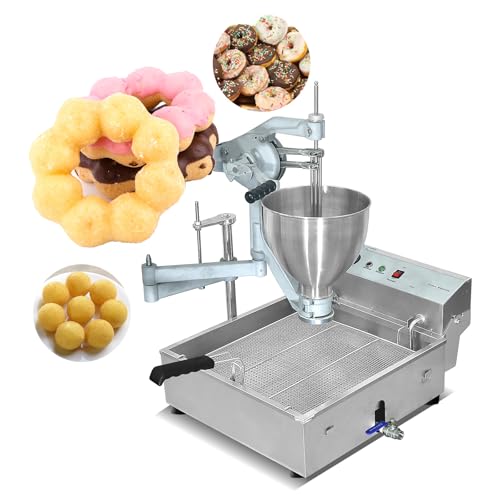
Equipped with three molds—ring, flower, and ball—this machine yields 500–2000 donuts per hour and includes a 9L hopper and 25L inner oil tank. Built from food-grade stainless steel, it emphasizes sanitation and durability. The 41.34″x25.6″x27.56″ dimensions and 35 kg weight suit mid- to large-scale operations. A drain hole improves oil management, and installation notes advise direct connection to a suitable power source due to high wattage.
Electric Mini Donut Maker Machine (Home Use) – Eapmic

This compact unit uses a double-sided heating design to bake blossoms quickly, producing five donuts in under five minutes. Temperature is adjustable from 122 to 572 Fahrenheit to suit preferred crispness or softness. It includes essential accessories—food holder, whisk, brushes, sponges—and a recipe guide, making it a practical option for home bakers and small gatherings seeking quick, fresh donuts without large equipment.
Buying Guide: Key Purchase Considerations
- Capacity and output: For high-volume operations, prioritize machines with 500+ donuts per hour and a large hopper (9L or more). Consider batch yield and whether the unit supports continuous production.
- Shape versatility: Look for three-mold systems (ring, mochi, ball) to expand your menu and appeal to diverse customer tastes.
- Power and installation: Heavier units (3000W) require dedicated circuits and proper wiring. Ensure your kitchen setup can accommodate electrical or gas connections safely.
- Construction and sanitation: Food-grade stainless steel is essential for durability and cleanability. Check oil tank capacity and drainage features for easier maintenance.
- Automation vs. manual control: Automated flipping and programmable thickness provide consistency and labor savings, while manual models offer simple operation and lower upfront costs.
- Size and space: Compare dimensions to determine placement in your kitchen or storefront. Larger units demand more floor space and stable mounting.
- Safety features: Verify air switches, enclosed wiring, and proper temperature control to minimize risk during operation.
- Service and parts availability: Favor brands with readily available replacement parts and responsive support for uptime reliability.
- Fuel source: Some models use electricity, others gas. Gas-powered units may reduce electricity use but require proper gas line installation and safety measures.